

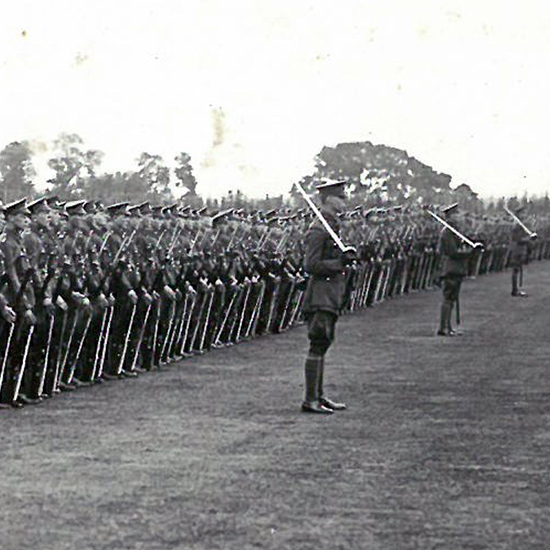
Tonbridge School and the Great War: Thomas Cocker

As we approach Remembrance Sunday and the centenary commemorations for the end of the First World War, the school is paying tribute to those among its ranks who served in the conflict, many of whom made the ultimate sacrifice.
By the end of the war 415 Tonbridgians had died, roughly the size of the school at that time. The Tonbridge death rate of one in five of those who served is the average across all public schools; the overall national death rate is one in ten. Death fell disproportionately on the young. About half of Tonbridgians killed were 24 years of age or under, and half of them were aged 20 or under. Most of them were junior officers in the Army.
Over the coming days we are highlighting some of the individual stories of Tonbridgians who served in the Great War.
Today we feature Capt. Thomas Edge Cocker.
For more about Tonbridge School and the Great War, including complete records of all who served, as well as features, calendars, a timeline and wartime copies of The Tonbridgian, please click here.
Capt. Thomas Edge Cocker
R.F.A., CROIX DE GUERRE. KILLED IN ACTION, IN FRANCE, MARCH 21ST, 1918. AGED 30.
Biographical extract from Tonbridge School And The Great War:
At the School 1899-1906 (Hill Side). Capt. T. B. Cocker was the only son of the late Capt. Thomas Edwin Cocker, of the Chinese Imperial Maritime Customs, and of Mrs. Cocker, now of Matheran, Radlett, Herts. Entering the School in May, 1899, he was appointed a House Praepostor in September, 1904, and a School Praepostor in January, 1906, and left in the summer of 1906 from the Science Sixth. He was in the XV. as a Half Back in 1903 and 1905, was in the Gymnastic Pair in 1906 and rowed Bow in the School IV. in his last Term. In the characters of the 1905-6 XV. he was described as very clever in starting attacks, and he and A. L. Henniker Gotley as an exceptionally fine pair of Halves.
At the sports in 1903 he won the Half Mile, Hundred, and Broad Jump under 16, and in the last established a record which has since been beaten. In the Cadet Corps he was promoted Sergeant in September, 1904, and from the following January was Sergeant Bugler in command of the Band. The excellence of the Band at that period was largely due to his skill with either bugle or big drum, and when the South African War Memorial Window was unveiled in June, 1905, by the Lord Lieutenant of Kent, he was one of the two buglers who sounded the “Last Post” from the sanctuary steps. In the choir he was a very useful tenor and he took a prominent part in the School concerts and Volunteer sing-songs of his day.
To read more, please click here.


