

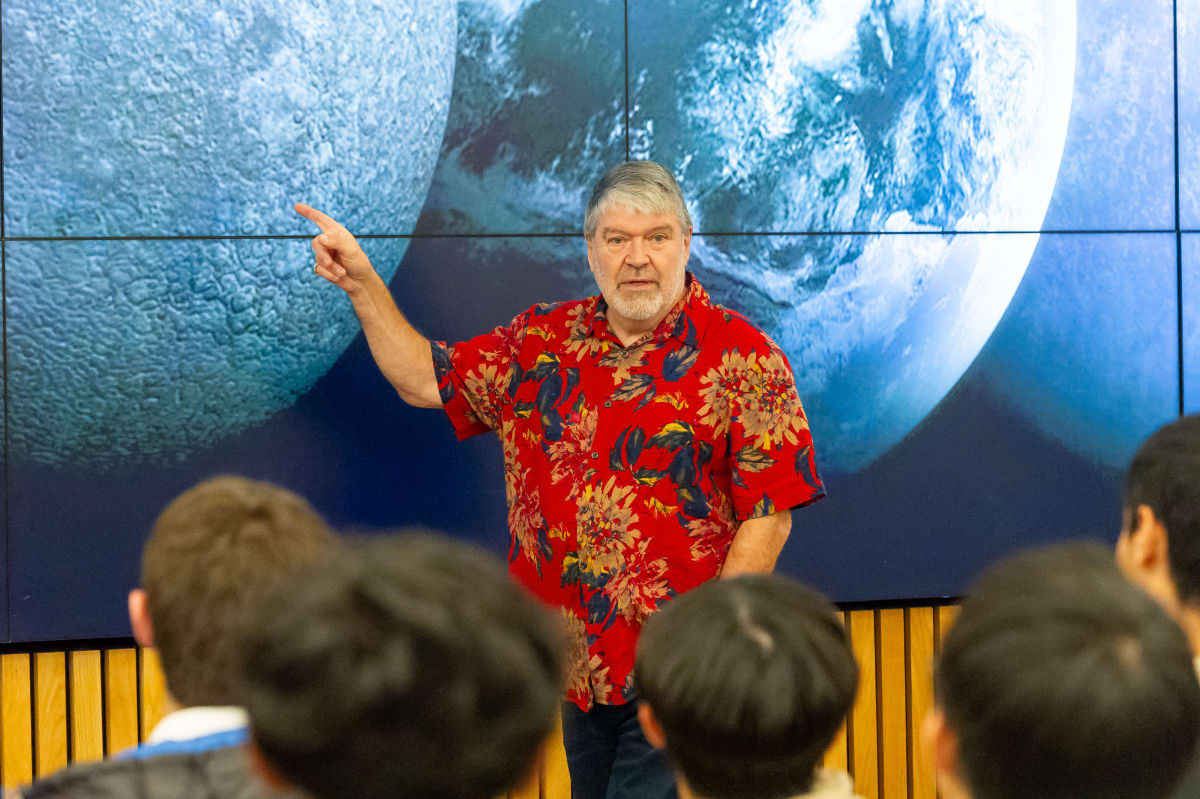
A Journey Through the Cosmos: Insights from Greg Smye-Rumsby
On Thursday, 10 October, Greg Smye-Rumsby, a tutor from the Royal Observatory in Greenwich, delivered a talk to boys as part of the Omniscience Lecture Series. The series invites distinguished speakers from a diverse array of scientific fields to share their expertise and insights. This series, which is open to all boys, aims to broaden horizons, inspire critical thinking, and encourage a love for learning across scientific disciplines.
Smye-Rumsby introduced the talk with a playful comparison between what our student body think aliens could like like, versus some more scientifically grounded theories. While we were pretty sure that beings like E.T. and those from War of the Worlds were unlikely candidates, few of us had considered his suggestion of a “carpet” of microbiological single-celled organisms.
He then discussed the perfect conditions for life on Earth, explaining that our planet is just the right size—any larger and we wouldn’t be able to escape its gravity; any smaller and our atmosphere would vanish. He also introduced us to the Drake Equation, which aims to predict the number of communicative civilizations there are in the Milky Way, with answers that range from 2 to 10,000. Regardless how many exist, we would still be hard-pressed to find one – he explained any signal would take hundreds of thousands of years to reach distant parts of our own galaxy —truly “far, far away,” as Star Wars would put it.
He also explored historical claims of alien life within our Solar System and various attempts to detect these elusive beings. For instance, in the 1920s, Nikola Tesla claimed that he had received radio signals from Mars, but these were later discovered to be spurious communications from a terrestrial source.
Even more fascinating was the establishment of the Pierre Guzman Prize, which offered £135,000 in today’s money to anyone who could successfully communicate with another planet. In pursuit of this prize, an enthusiastic astronomer named Fred Cummins constructed hundreds of radio kits, each finely tuned to a narrow band of frequencies in hopes of reaching out to extraterrestrial worlds. Unsurprisingly, the experiment was unsuccessful, leaving behind hundreds of delicately crafted yet utterly useless “Guzman boxes.”
After the talk, he set up a telescope for us to observe the Moon’s craters and even managed to find Saturn through the cloudy night sky, its rings clearly visible. While we hoped to catch a glimpse of aliens through the eyepiece, Mr. Smye-Rumsby grounded our expectations, reminding us that we shouldn’t anticipate finding advanced life in our universe. After fielding a few more questions, he proposed an intriguing idea: silicon-based life forms might exist out there, possibly even right under our noses! So, what could they be? Well, it’s simply something we call AI.


