Astronaut talks about life on board the ISS

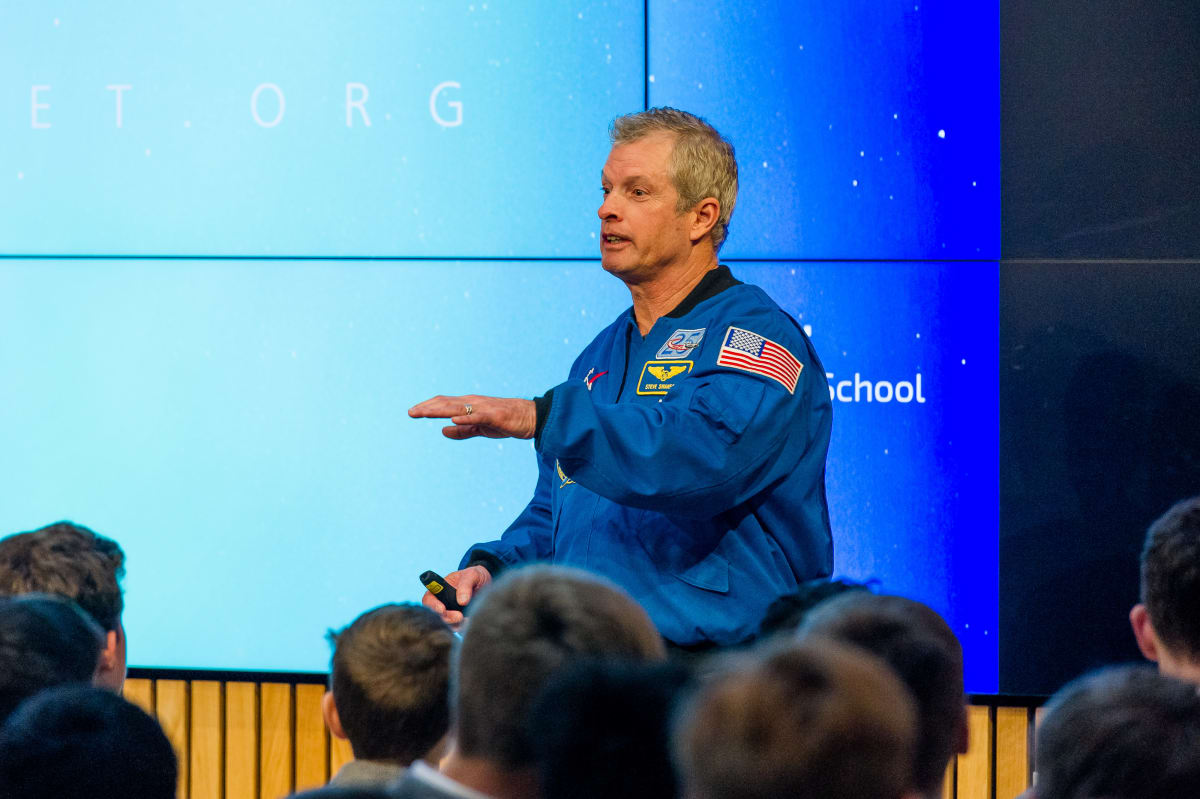
Students heard about what it is like to live and work in space during a talk at Tonbridge School on Wednesday (20 March).
The talk by Dr Steve Swanson, called Commanding the ISS (International Space Station), formed part of Mission Discovery Week at the school.
Students from various schools in Kent are taking part in Mission Discovery, one of the country’s most prestigious science and technology programmes. Tonbridge is the first UK school to host the event.
Dr Swanson, a NASA astronaut and an engineer, has flown on two Space Shuttle flights, STS-117 and STS-119, and has been the Commander of the International Space Station Expedition, which involved launch and landing in the Russian Soyuz capsule.
He has logged over six months in space, travelled 83 million miles, completed four spacewalks and has been awarded the NASA Exceptional Achievement Medal.
His talk covered his early years (“I wanted to be a mountaineer until I realised there was no real career to be had,”), the process of getting astronauts from a space shuttle on to the International Space Station, and what life was like when finally aboard for a six-month stint.
“Being in space is like ageing quickly,” he revealed. “You suffer muscle loss and your immune system struggles, and so part of our research was in looking at ways to combat this. We carried out lots of small experiments on our bodies, to see how our body chemistry was changing. In some ways were like guinea pigs,” he said.
Dr Swanson told students that each astronaut exercised for two hours a day on board the ISS, and that it took around ten days to retain normal balance after landing back on Earth. “Your strength takes around six months to get back to normal,” he added.
Meal times consisted of eating food from packets with a spoon. He grew some edible lettuce while in space, and quickly became used to the lack of gravity. “It becomes quite normal having things floating around you, and grabbing them from the air,” he said, comparing the size of the International Space Station to that “of a large jet, like a 747”.
Talks from Dr Swanson and from Dr Michael Foale, the first British NASA astronaut, are continuing this week as part of the Mission Discovery programme.
At the end of the course, an experiment designed by students will be chosen as the winner and will later be flown into space, where it will be carried out by astronauts aboard the ISS.